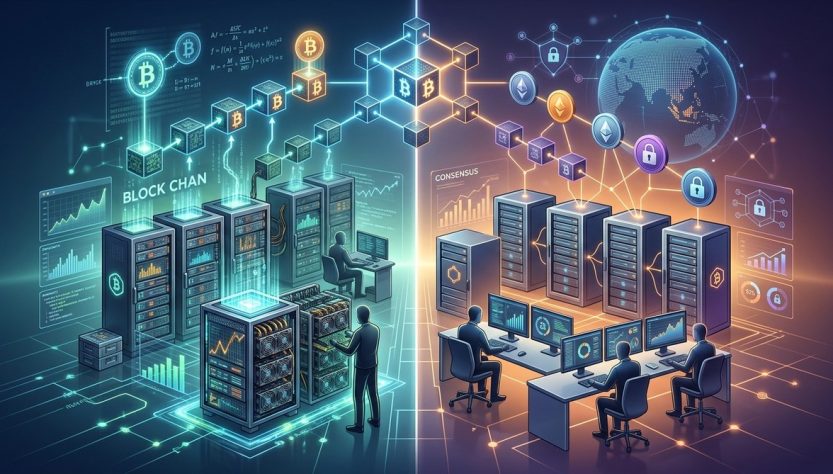
The blockchain doesn’t run on magic. It runs on a careful division of labor between participants who build the chain and participants who check the work. If you have ever wondered why some networks consume enough electricity to power a small country while others run on a laptop, the answer lives in the split between miners and validators. These two roles handle the same job, keeping the ledger trustworthy, but they go about it in completely different ways.
Miners and validators both secure blockchains but use opposite strategies. Miners compete to solve cryptographic puzzles using massive hardware, which consumes energy but provides strong censorship resistance. Validators stake capital and are chosen by algorithm, offering efficiency at the cost of different trust assumptions. Your choice between them determines your network’s security model, energy footprint, and decentralization level.
The Core Distinction Between Production and Verification
Think of a blockchain as a public notebook. Miners are the people who get to write a new page. Validators are the people who check that every page follows the rules before the notebook gets passed around. In proof of work systems like Bitcoin, miners both produce and validate, but the roles are still separate in function. In proof of stake systems like Ethereum after the merge, validators take over both duties without ever mining.
The confusion happens because the industry uses the word “mining” to describe two different things. In proof of work, mining means racing to find a number that makes the block hash start with enough zeros. In proof of stake, there is no race. Validators are selected based on how much cryptocurrency they lock up as collateral. Both methods produce the same result, a confirmed block, but the security guarantees differ.
How Miners Secure the Network Through Proof of Work
Miners are the heavy lifters of the blockchain world. They run specialized hardware, application specific integrated circuits or ASICs, that churn through trillions of guesses per second. The goal is simple: find a nonce value that, when combined with the block data, produces a hash below a target threshold.
Here is how a Bitcoin miner processes a block:
- Collect all pending transactions from the mempool and build a candidate block.
- Add the coinbase transaction that pays the mining reward to their own address.
- Hash the block header with a random nonce value.
- Check if the resulting hash is below the current difficulty target.
- If it is not, increment the nonce and try again.
- Repeat steps 3 through 5 until a valid hash is found or a new block arrives from another miner.
- Broadcast the winning block to the network for everyone to verify.
The security comes from the work itself. To rewrite history, an attacker would need to redo all the work for every block after the point of change. That requires more hashing power than the rest of the network combined. As of 2026, the Bitcoin network’s hash rate sits around 600 exahashes per second, making a 51 percent attack financially impractical for any single entity.
What Miners Actually Validate
When a miner finds a valid block, they do not just throw it onto the network. They perform several checks first:
- Every transaction must have valid signatures.
- No transaction can spend coins that do not exist.
- The block must reference the previous block’s hash.
- The timestamp must be reasonable, not too far in the past or future.
If any of these checks fail, the miner discards their own work and starts over. The economic incentive is strong. Broadcasting an invalid block wastes electricity and earns nothing.
How Validators Secure the Network Through Proof of Stake
Validators in proof of stake systems take a different approach. Instead of burning electricity, they burn opportunity cost. To become a validator, you lock up a significant amount of the network’s native token. This stake acts as a security deposit. If you validate honestly, you earn transaction fees and sometimes new tokens. If you validate fraudulently, the network slashes your stake.
Ethereum’s proof of stake mechanism works through a process called attesting. Validators are chosen randomly, weighted by the size of their stake. The selection happens one epoch ahead, so validators know when they will be called. This predictability allows them to run on standard server hardware rather than specialized mining rigs.
The security model is economic rather than physical. To attack a proof of stake network, an attacker must acquire a large portion of the total token supply. Buying that much on the open market would drive the price up, and if the attack succeeded, the token value would crash, destroying the attacker’s own capital. This creates a strong disincentive against misbehavior.
The Slashing Mechanism
Proof of stake networks use a penalty system called slashing to enforce honesty. If a validator signs two conflicting blocks for the same slot, any other validator can submit proof of the double sign. The network then destroys a portion of the offending validator’s stake and gives a reward to the whistleblower.
This creates a game theory situation where honest behavior is the only rational choice. The cost of cheating is higher than any possible reward from doing so.
Proof of Work vs Proof of Stake: A Side by Side Comparison
The table below breaks down the practical differences between the two approaches. Use it as a reference when evaluating which consensus mechanism fits a given use case.
| Attribute | Proof of Work (Miners) | Proof of Stake (Validators) |
|---|---|---|
| Hardware needed | ASIC miners, high power cooling | Standard servers, consumer hardware |
| Energy consumption | Very high, comparable to small countries | Low, similar to running a few servers |
| Entry barrier | Expensive hardware and electricity | Token purchase and stake lock up |
| Censorship resistance | Extremely high, anyone with hardware can mine | Moderate, depends on token distribution |
| Finality speed | 10 minutes per block on Bitcoin | 12 seconds per slot on Ethereum |
| Environmental impact | Significant carbon footprint | Negligible carbon footprint |
| Attack cost | Must control 51% of hashrate | Must control 51% of staked tokens |
| Reward distribution | Winner takes all per block | Proportional to stake, regular payouts |
Why Some Blockchains Use Both Roles
Not every network fits neatly into one camp. Some blockchains, particularly enterprise distributed ledger platforms, separate the roles intentionally. In a permissioned blockchain used by a consortium of banks, one set of nodes might be designated as block producers (the miners) while a different set acts as validators.
This separation allows for fine grained control over who can write to the ledger versus who can verify. A bank might run validator nodes to check the work of a third party mining service. The validators never mine, and the miners never validate. Each side keeps the other honest.
For a deeper look at how these roles function in different network architectures, check out our guide on understanding blockchain nodes: validators, full nodes, and light clients explained.
Common Misconceptions About Mining and Validation
Several myths persist even among experienced developers. Let’s clear them up.
- Miners are the only ones who secure the network. This is false. In proof of stake, validators do all the security work without any mining. Even in proof of work, full nodes that do not mine still validate every block and transaction.
- Validation is easy and unimportant. Validation requires running the same cryptographic checks that miners do. A validator must verify every signature, check every balance, and confirm every hash. Skipping validation is how nodes get tricked into accepting invalid blocks.
- Proof of stake is less secure than proof of work. Both have trade offs. Proof of work is vulnerable to a 51 percent attack if someone controls enough hashrate. Proof of stake is vulnerable to a similar attack if someone controls enough tokens. Neither is strictly superior.
- You need expensive hardware to participate. This depends on the network. Bitcoin mining requires ASICs. Ethereum staking requires only a reliable internet connection and enough ETH to meet the minimum stake.
“The security of a blockchain does not come from mining alone. It comes from the combination of block production and independent validation. A network where every node validates is far more resilient than one where only producers check the work.” – Lead Protocol Engineer at DLT Singapore
The Practical Process of Validation
Whether you call them miners or validators, the actual validation process follows a similar pattern across most blockchains. Here is the step by step flow that happens after a new block arrives at a node.
- Check the block header. Verify that the previous block hash matches the node’s copy of the chain tip.
- Verify the proof. In proof of work, check that the block hash meets the difficulty target. In proof of stake, check that the block was signed by an authorized validator.
- Validate every transaction. Check signatures, balances, and nonce values. Reject any transaction that tries to spend unspendable outputs.
- Execute any smart contracts. For networks like Ethereum, run the bytecode of any transactions that call contract functions.
- Update the state. If everything passes, apply the transactions to the local copy of the ledger.
- Propagate the block. Send the validated block to peers so they can repeat the process.
Each node performs these steps independently. There is no central authority that tells nodes which blocks to accept. This is what makes the system decentralized. If one node tries to accept a bad block, the rest of the network rejects it, and the rogue node gets isolated.
Enterprise Implications for Choosing Miners or Validators
If you are building a blockchain solution for a business in Singapore or anywhere in Southeast Asia, the choice between mining and validation based consensus affects your operational costs and security model.
Enterprise blockchains often use proof of stake or similar mechanisms because they are cheaper to run. A consortium of ten banks does not need to burn coal to secure their ledger. They can run validator nodes on existing server infrastructure and achieve the same security guarantees with lower overhead.
However, the trade off is that proof of stake systems tend to concentrate power among the largest token holders. If one bank holds 40 percent of the staked tokens, they have outsized influence over which blocks get accepted. For some use cases, like a government land registry, this centralization is unacceptable. Those applications might prefer proof of work or a hybrid model.
For more context on how different architectures fit business needs, read our comparison of public vs private blockchains: which architecture fits your business needs.
How the Roles Evolve in Modern Networks
The line between miners and validators continues to blur. Ethereum’s transition to proof of stake in 2022 eliminated mining entirely from the network. Newer blockchains like Solana and Avalanche use variations of proof of stake with additional mechanisms for speed.
Some networks experiment with proof of history or proof of authority, which further redefine who gets to produce blocks and who gets to check them. The core concept remains the same: one group proposes new blocks, another group verifies them. The exact mechanism is just implementation detail.
As a developer or architect, you should think about the security properties you need rather than the terminology. Do you need maximum censorship resistance even if it costs more energy? Choose proof of work. Do you need high throughput and low fees? Choose proof of stake or a delegated validation model.
The Real Guardians of Your Blockchain
The security of any blockchain depends not on whether it uses miners or validators, but on the distribution of power among them. A network with one dominant miner or validator is not secure, regardless of the consensus mechanism. A network with thousands of independent participants, each running their own validation checks, is secure even if each participant has modest resources.
The next time you send a transaction, remember that dozens or hundreds of machines around the world are competing or cooperating to confirm it. Some of them are burning through electricity at an astonishing rate. Others are staking their capital on the line. All of them are running the same cryptographic checks to make sure your transaction is valid.
That is what secures your blockchain. Not the name of the role, but the distributed nature of the work. No single party controls the truth. The truth emerges from the collective effort of every miner, every validator, and every node operator who chooses to participate honestly.
If you are building a blockchain project and want to understand which consensus model fits your requirements, reach out to our team at DLT Singapore. We help enterprises across Southeast Asia design distributed ledger systems that balance security, cost, and decentralization.